Posts by admin.

CATALOGUES & BROCHURES

2018: Troy Gronsdahl and Ellen Moffat in conversation: https://remaimodern.org/field/read/a-little-piece-of-string-ellen-moffat-in-conversation-with-troy-gronsdahl

2015: Blair Fornwald, “On Language and the Limits of Legibility”, At the Dunlop, July 2015

2011: J Morton: “Let’s Be Clear: Metaphor and Music in the Media Art of Ellen Moffat”, PAVED Arts, Saskatoon

2011: Charlotta Kotik, “Marking Space, a Collaborative Drawing, Performance and Sound Project”, Kentler International Drawing Space, Brooklyn

2009: COMP OSE, College | Kenderdine Art Gallery, DVD, essays by A Gérin, M Lovrod, intro by Kent Archer

2005: Fault Lines, MacKenzie Art Gallery, DVD & Audio CD, intro by P Deadman

2005: Guessed House, AKA Gallery, Saskatoon, essay by Donna Wawzonek

2004: BLOW, Mendel Art Gallery, Saskatoon, essay by Betsy Warland, Audio CD

2002: Re-Imaging the Prairie Icon, catalogue, essay by David Garneau, The Little Gallery, Prince Albert

2000: The Infinite Between, essay by Leslie Thompson, Gallery 44, Toronto

1999: Fixations, essay by Robert Zingone, Mount Saint Vincent University Art Gallery, Halifax

1999: Shades of Black and White, artist book/catalogue, essay by Vera Lemecha


ANTHOLOGIES

2015: Urban Encounters, Martha Radice & Alexadrine  Boudreault-Fournier, ed., McGill-Queen’s University Press (upcoming)

2009: Sighting, Citing, Siting, K Irwin & R MacDonald, ed., Canadian Plains Research Centre, Regina

2008: Playing with Words, Cathy Lane, ed., CRiSAP, London College of Communication, London


JOURNALS & PRESS (Selected)

2014: Yam Lau, “A Case in Physiognomic Reading”, BlackFlash Magazine, Winter

2009: Marie Lovrod, “Sounding Capacities for Co-Creation”, FUSE, Summer

2006:  K Wilson, “Mama Wetotan/Crossfiring: The Claybank Project”, BlackFlash, Spring, V 24.3

2005:  J Anderson, “Ellen Moffat: Fault Lines”, Border Crossings, Spring No. 94

2004:  A Gérin, “BLOW (Radical Poetry)”, Espace, Fall

2003:  “Speculations and Speculative Fictions”, Martha Rosler with FLEAS, Art Forum, Nov

2002:  S Vida, “Passage: The Photographic Works of Ellen Moffat and…”,  BlackFlash, Sept. V 20.1

2002:  G Beatty, “Spasm”, Artichoke, Winter

2002:  D Wilson, “Spasm”. Mix Magazine, Summer

1999:  “The Crossing” Surveyor / Eye, Saturday Night, May

1998:  J Anderson, “Examining our capacity for imagination”, Leader-Post, Dec. 5

1996   G Beatty, “Artist-in-residence in Ft Qu’Appelle…” Leader-Post, Dec. 21

1995   K Donovan, “Art as Criticism”, Newest Review, June/July

1995  G Beatty, “R Chambers & E Moffat, Inside Outside”, Espace, vol. 31, Spring


PUBLISHED ART WRITING

2014: “To Play or To be Played Article” DAG Volumes, Dunlop Art Gallery

2012: “Affective Space, Locative Bodies” with Kim Morgan, Ambiances International, Montreal

2012: “Sounding Space”, Blackflash, Saskatoon

2011: “The Circulation of Fluids: Catherine Béchard & Sabin Hudon”, AKA Gallery, Saskatoon

2009: “Media Art, Interactivity & Play”, with Michelle Kasprzak, BlackFlash 2.0 Project, Saskatoon

2008: “Claybank Voices…”, Siting, Sighting, Citing, Canadian Plains Research Centre, Regina

2007: “the colour of (an) echo”. aneco new public art, City of Saskatoon, SK

2007: “Claybank Voices: The Specificity of (T)here”, Canadian Theatre Review, U of T Press

2006: “Of Reputations and Memories”, Secret Regina, Canadian Plains Research Centre, Regina

2005: “Blur: Andrew Forster’s Cinema”, Fuse Magazine, Toronto

2004: Off the Map, a conversation with Jack Anderson, Dunlop Art Gallery, Regina

2004: Spasm: The Couture of Contemporaneity, Paved Art+ New Media and AKA Gallery, Saskatoon

2003: “beyond the local: green and rootless”, Spasmodic: A Public Affair, paved Art + New Media, Saskatoon

2001: “Mike MacDonald: Touched by the Tears of a Butterfly”, Interplay, The Photographers Gallery, Saskatoon

2000: Ascensions: Karen Skoronski, The Little Gallery, Prince Albert

2000: Mon Travail: Andrée Martinson, The Little Gallery, Prince Albert

1999:“Art and Anonymity”, The Craft Factor, Winter Vol 23.3

1998/99: “Artists in Their Studios: Profiles”, CARFAC Newsletter (March, May)


ARTIST BOOKS

2001: Transitive, artist book/catalogue, with Audio CD

Claybank Voices (2006)

Art Gallery of Swift Current

cv_sc_compil

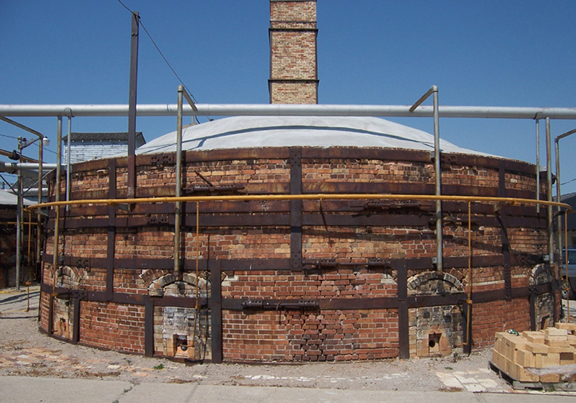
The gallery installation of Claybank Voices is modified from its original site-specific installation in Mama Wetotan/Crossfirings (See OFF-SITE + PUBLIC ART for a complete description) by incorporating industrial artifacts from the brick factory site and video by Ken Wilson (a participant in Mama Wetotan/Crossfirings). Wilson reworked Dick Bird’s 1940’s film footage of workers and the process of brick production. The video strengthens the connection of sound, site and history as co-operative production.

<LISTEN> ClaybankVoices 1’33

BLOW (2004)

BLOW weaves together two voices – one male, one female – as fragments of semantic and grammatical speech in a polyphonic composition. Breath, utterance, syllables and phrases offer a cut-up audio poem of sentience and rationality using high/low technology and aesthetics in twelve tracks of spatialized sound. The text juxtaposes sense and sensuality of subjective, collective positions and utopic possibility. A cartographic text-map fusing concrete poetry with a schematic of the nervous system of the human body is projected on one wall as a techno-organic graphic. Catalogue with Audio CD; essay by Betsy Warland. Collection of the Saskatchewan Arts Board.

<LISTEN> BLOW 1’00

Claybank Voices: How Men Made White Mud into Cape Canaveral (2006)

Mama-Wetotan/Crossfirings: The Claybank Project, Claybank, SK

claybank2

Claybank Voices is a 24-channel sound installation of spoken word, music and machinery sounds as a meditation on labour history and the transition of a site of industrial production into one of cultural presentation. Audio speakers, placed in the flue holes of the kiln, broadcast sound to interior and exterior spaces. The script was developed as a ‘found’ document from archives and recorded by community members as local, non-professional voices. The fugue movement from Benjamin Britten’s Cello Suites was recorded in situ. Factory sounds include a brick press, tamping press, metal lathe and factory whistle, all from the site. Together, the multiple voices, industrial sounds and classical music propose an eighteen minute polyphonic composition of deconstructed sound with a seven-voice chorus.

claybank_detail

claybank_speaker

<LISTEN> ClaybankVoices  01’33

sensing sound | sounding sense

… trees have roots, but people have

mobile imaginations and bodies,

mutable interfaces for navigating the world.

(Roland Jean)


The senses with which we engage with the world shape the sense we have of the world. Sound affirms embodied experience, sensorial knowing, and the dynamic relations of sound and space. The listener makes sense of sound from within the transience and ceaseless fluctuation of sound. The materiality of sound raises questions about what was heard. The certainty of the visual – the stability of objects, the centred subject, borders, and logocentric knowing – is contested. Sonic materiality and temporality cause doubt.

How we listen to sound informs how we hear each other and the world. Sound connects the listener to others and to the world through embodied knowing, visceral sensation, and affect. The listener is in continual production with  sound’s non-sense while making sense of its fluctuation. Sound, bodies, forces of energy matter, and the world intertwine in their becoming relations and transpositions. The different rhythms of sounding bodies affirm the diversity of the sounds of others, the subjective and intersubjective engagement of listening, and the present-ness of sound’s fluctuation. We hear the world as relations, interrelations, and transformation.

Small sounds draw me into their fluctuating tones and temporalities as if they are the beginning of language of the un(der)heard and (in)audible and of sound as a life force. The particularity of their soundings evokes the multiple subjectivities and pluralities of differences and otherness. Meaning is contingent, understanding incomplete. The listener constructs sense within the presence and absence, transience, and temporality of sound’s materiality. Listening and hearing intertwine in embodied relations of sense and nonsense, sonic materiality, and otherness as Voegelin’s sonic possible, an alternate world that reveals how the world might be and the social and political implications of this possibility.

ReCALL (2005)

Residency project, Confederation Centre for the Arts, Charlottetown

recall

ReCALL is a video projection in a storefront window in downtown Charlottetown. During the residency, I developed a textual inventory of smells, rhythms, folklore and colloquialisms as the “invisible residue” of place with input from a cross-section of folklorists, librarians, artists, business people and old-timers. The juxtaposition of text, digital images and scanned maps of the island posited the local voice, local traditions, collective knowledge and personal memories in the public arena. Ambient street noises provided a real-time sound scape.

Civil Fugue (2004)

Future Cities, Art Gallery of Hamilton

civilfugue3

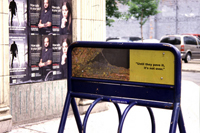
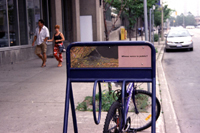
Civil Fugue uses the panels of bicycle stands in downtown Hamilton to mount twelve image and text panels as a gesture of repositioning local voices in the public sphere. The text was generated through meetings with participants from diverse sectors in the city as a sampler of attitudes about the future public space in Hamilton. Juxtaposed with a satellite image of Hamilton, the text maps the voice as a live feed of public opinion.

civilfugue10200 civilfugue5200

Guessed House (2004)

AKA Gallery, Saskatoon

guessedhouse-monika

The three-person, two-part project with Linda Duvall and Rachelle Viader Knowles involved a performative action in a house of a total stranger and a subsequent gallery installation. The action of inhabiting the house of a stranger for a weekend (the owner spent the time at a holiday hotel) was intended to open up an exploration of questions relating to home, fiction and boundaries. We never met the owner. The resulting exhibition used a loose interpretation of the initial experience.  Catalogue with essay by Donna Wawzonek. Exhibited at AKA Gallery, Saskatoon.

In Our Beautiful Future (2003)

Utopia Station, Arsenale, Venice Biennale

beautifulfuture2

In Our Beautiful Future was an eight-person collaborative banner and poster project with Martha Rosler and the FLEAS Collective, an international group of socially-engaged artists. As a collective project on the theme of utopia, each member’s contribution was autonomous; as an assemble, they presented a heterogeneous voice.

beautifulfutureMy panel layers text on a satellite image of Saskatchewan as a opinion feed reflecting utopian dreams from my community. In the context of the Utopia Station Project at the Venice Biennale, local voices are brought into the international forum as a gesture of global connectivity. The banner was subsequently printed in Austrian newspapers through the Museums in Progress.
TRACK (2002)

track23002

Prince Albert and Saskatoon

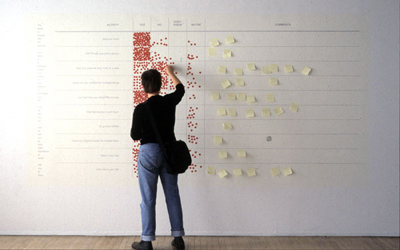
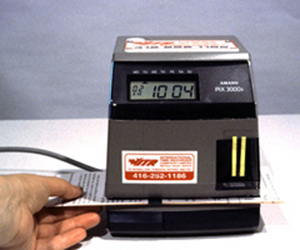
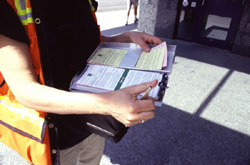
Track is an interactive public survey about time, daily activity and location. Participants clock in on a digital time recorder to enter the work; they receive a copy of a time sheet as a receipt. Then they proceeded with their business. To exit the work, they need to clock out with me and the time recorder. Participants who do not punch out live in the work for the rest of their lives.

track250track1250

There are two versions of the project. Track 1 surveyed the public space in downtown Saskatoon. I positioned myself in sites including street corners, park benches and a street market to engage with potential participants as faux scientist-surveyor. This version was part of the SPASM Public Art Project in Saskatoon. Track 2 used a gallery as its sociological site. Participants punched the time recorder upon entering and exiting the gallery, recording the length of time they spent in the gallery and with art. The results were published in the Gallery’s newsletter as a public record. The Little Gallery, Prince Albert.


PLAY (1998)

play400

City of Regina

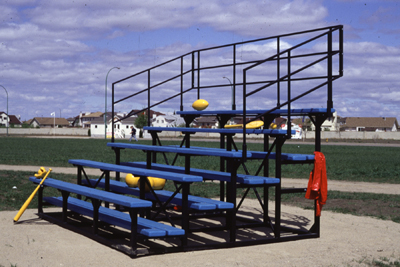
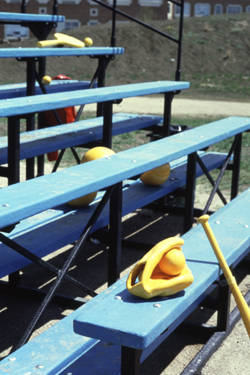
PLAY is a functional spectator bleacher that also supports brightly coloured modernist fibreglas objects – sports equipment (baseball, soccer, tennis) and associated sports gear (jacket, running shoes). PLAY was commissioned by the City of Regina for the Lakeridge Sports Park, adjacent to a high school in Regina.

play_jacket300 play_baseball250