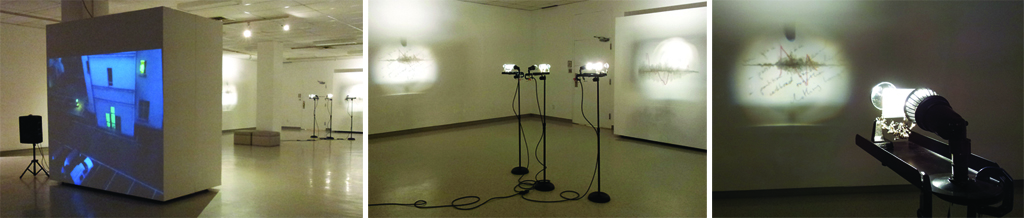
Small sounds, image, text, rhythms, and tonalities bleed into and mix with each other, transgressing the borders of space and containment. A techno-organic sound installation of matter and found materials is transcribed into an evolving notation of sound objects and text. Video animations mix and remix the language of sound in fleeting text-images of sense and non-sense. A bench-platform augments the physical sensation of sound. The sonic sensibility of becoming, beginning, undoing, and redoing connects the listener to sounds of difference and to language as a new symbolic space of subjective, objective, and collective relations. Sound, text, the senses, and cognition perform their becomings and beginnings, undone again.
Sound Installation & details: becoming again beginning undoneProjection & Sound Bench: becoming again beginning undone
she i her is an open work of image, text, video, sound and light. Language(s) intersects with somatic rhythms, experimental writing with structure, and knowing with uncertainty with overlapping subjectivities. Texts by Woolf, Stein and Cixous, and walking through Parisian streets as a dérive were my influences and process. I privileged direct experience before language. Woolf and Stein’s texts opened up the imperceptible and chance, stream of consciousness and language/word play. Cixous proposed writing as a form of journeying through the world using one’s body as transport. The project is an iterative exploration of processes, materials, visualization and analysis of sound.
The interdisciplinary installation uses disjunctive elements, integrated as a poetic, conceptual and progressive inquiry into language, translation and transcription. Media includes videos as animated notation, performative text and field recordings using projection and flat screen monitors and intoned sound (vocal, strings and virtual piano. Laser-cut prints on paper are glyphs of the original text. The project has been exhibited in solo and group exhibitions.
Gordon Snelgrove Gallery, University of Saskatchewan
Posted by ellen at 8:11 am on March 24th, 2016.
Categories: MULTI-MEDIA.
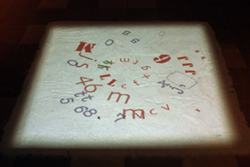
Playing with Gertrude is an interactive installation for sound and image creation inspired by poems from Stein’s Tender Buttons. Objects and text(s) are props, players and instruments. Participants perform the installation as direct actions triggering spoken word recordings and creating new sounds and text-images through experimentation, play and interaction. Sound is output to 8-channels; text-images are projected as a live feed.
Co-production residency of Charles Street Video and NAISA, Wychwood Barns, Toronto. Also see Performative: Book Table Chair.
Place Markers: Mapping Locations Probing Boundaries, curated by Peter Dykhuis
Dalhousie Art Gallery, Halifax
in pulse, a collaboration with Kim Morgan, is a research-driven project using mobile technologies to collect bio-data (heart beat) and locative video as an inquiry into affect, bodies and urban space. Our first site was Paris. We collected data in select arteries of the city – La Defense, Les Passages, Bastille Market, Forum des Halles, Layfayette Department Store, La Gare du Nord – using a dérivian structure of chance encounters and play. Our field recordings took into account different ways individuals – ourselves and other people – reacted to and experienced people, places and things. As a gallery installation, projected video was synchronized to the sound of the differentiated rhythms of our pulses amplified through subwoofers, emphasizing the eye and somatic presence of each of us. Raw video footage was presented on a Google map.
in pulse is part of a three-year SSRHC Research and Creation Grant, Tracing the City: Interventions of Art in Public Spaces. Subsequent locations for our field work were Halifax, Regina and Saskatoon.
College AG (Saskatoon), Doris McCarthy AG (Toronto), Thames AG (Chatham)
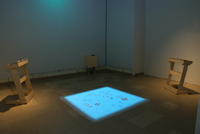
twicescore is a visual poetry instrument using dual keyboards and physical controllers. Two keyboards provide physical interfaces for text generation with controllers for manipulation of type as typographic design. The separate texts are projected as integrated concentric circles onto a bed of glass bead on the floor. Poems can be posted to a web site as a publishing outlet and public archive. Inspired by “zuverspaetceterandfigurinnennenswert ollos”, a 1962 rota-poem by Ferdinand Kriwet, the project fuses interactivity, co-authorship and concrete poetry.
The gallery installation of Claybank Voices is modified from its original site-specific installation in Mama Wetotan/Crossfirings (See OFF-SITE + PUBLIC ART for a complete description) by incorporating industrial artifacts from the brick factory site and video by Ken Wilson (a participant in Mama Wetotan/Crossfirings). Wilson reworked Dick Bird’s 1940’s film footage of workers and the process of brick production. The video strengthens the connection of sound, site and history as co-operative production.
BLOW weaves together two voices – one male, one female – as fragments of semantic and grammatical speech in a polyphonic composition. Breath, utterance, syllables and phrases offer a cut-up audio poem of sentience and rationality using high/low technology and aesthetics in twelve tracks of spatialized sound. The text juxtaposes sense and sensuality of subjective, collective positions and utopic possibility. A cartographic text-map fusing concrete poetry with a schematic of the nervous system of the human body is projected on one wall as a techno-organic graphic. Catalogue with Audio CD; essay by Betsy Warland. Collection of the Saskatchewan Arts Board.
Fault Lines offers a personal yet anonymous impression of place using still and moving image, text, light and sound as fleeting moments. During a visit to a Torontoneighbourhood of my formative years, I explored my beat as a mnemonic gesture of presence and absence, subjectivity and poetics using association and resonance. My agency suggests Proustian memory, the flaneuse and the faux scientist within a structure of intention and chance. The experiential installation proposes an environment of rhythm, repetition, silence and shadowy half-light. Catalogue with DVD (video) and audio CD. Collection of the MacKenzie Art Gallery.
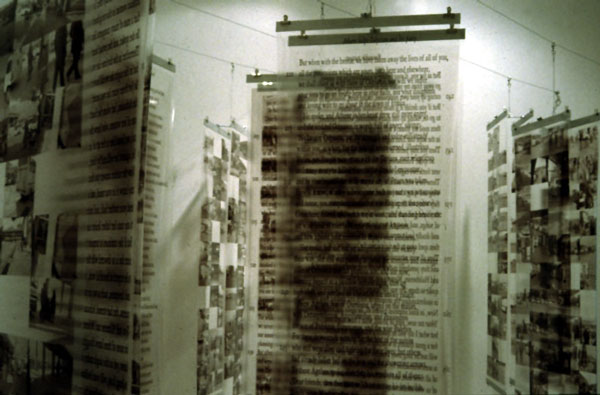
Travel blends experiences of the exotic and mundane, present and historic, and assumption and fact. I prefer to travel slow on local, ground transport systems with historic texts as companion material. During a 9-week trip to Turkey, I photographed every transit point en route (airport and ferry terminals; bus depots; street corners and roadsides) as an ironic tourist gesture of place-in-between-Place and place-before-Place. I digitized and output the images onto panels of acetate as a chronological photo-journal juxtaposed to panels with textual excerpts from the Odyssey as the Grand Narrative. A three-voice spoken word sound track combined personal narrative, history and interpretation using diaristic fragments, anecdotes and quotation. Artist booklet with audio CD. Saskatchewan Tour with SCAM.
Posted by ellen at 2:45 pm on December 21st, 2008.
Categories: MULTI-MEDIA.
Shades of Black and White used drawings by children to probe the question of our relationship with technology. Grade 3 students from diverse geographic regions, cultural groups and economic sectors in Saskatchewan made drawings of their daily extra-curricular activities. Reprocessed as slides, the images were incorporated into a multi-media installation with symbolic objects (school desks, sand, swing) and technologies (slide, filmstrip projectors, motorized swing) of the classroom, playground and childhood. The low-tech discursive environment of image, text, kinetic sculpture and sand offered a glimpse into their (and our) relationship with technology. Artist book/catalogue with essay by Vera Lemecha.
Posted by ellen at 2:44 pm on December 21st, 2008.
Categories: MULTI-MEDIA.